


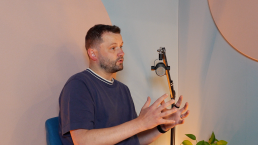
I joined Hippo in 2017 as employee number six, after 13 years in the civil service, including DWP’s early GDS-era transformation. Back then, many departments were running their first discoveries and alphas, and the GDS Service Standard was still new. A new project didn’t start by exploring solutions, because for years government had too often jumped straight to an assumed one. The early weeks went on understanding users, forming a team and agreeing ways of working. Most of the groundwork of understanding didn’t exist, so someone had to lay it.
Hippo turned ten this year. Since 2016 we’ve worked with more than a hundred clients on over a thousand projects, and we laid a lot of that groundwork alongside them. Much of it is now in place, and that changes what the first weeks of a new project can look like.
From first principles to a head start
Early digital programmes started from a blank page because there was nothing else to start from. Research had to be done fresh, patterns had to be designed and tested, and teams had to earn trust in agile delivery. Ten years on, a lot of that work can be reused.
Most of what carries from one project to the next is public or shared by design: open standards, the GOV.UK Design System, published patterns, component libraries that clients have chosen to share across their services, and the experience our people bring with them.
On one long-running public sector project, a single component built for one service went on to be reused across four separate products in the public and private sectors. Each product inherited the accessibility fixes and design learning of the last, without repeating the research behind them.
Reuse doesn’t remove the need for research. It frees research up to go where it matters: the questions nobody has answered yet, and the assumptions that are risky and untested.
Prototyping earlier, with evidence behind us
Phased delivery gave government a disciplined way to test assumptions before committing money, and it still does that job when uncertainty is high. But we now start most projects knowing far more than anyone could in 2016, so we size discovery to the uncertainty.
Discovery and alpha still ask different questions. Discovery asks what the problem is. Alpha asks how best to solve it. But they no longer have to be stages a whole service passes through in turn. Prototyping is now cheap and quick enough to be one of the ways discovery learns.
One misconception I still see is that you can’t prototype in discovery. You can, and teams always could, usually with high-level conceptual prototypes. What’s different now is that where the evidence already exists, we can prototype and test a fuller, end-to-end product or service in the first weeks, and keep deeper discovery for the questions that are still open. That is the Service Standard working as intended: understand users and their problems, and show the evidence for every decision.
The Standard never asked for waterfall. Each phase was meant to be iterative. In practice, funding, procurement and assessment at each gate often pushed delivery into a straight line, and that’s the left-hand picture below. The right-hand picture is how we think about it now.
I think of it as moving away from linear delivery to something more like an elevator. The floors are the kinds of work: understanding, designing, building and running. It isn’t the whole service that rides the elevator. Each assumption does. At any moment, different parts of a service sit on different floors, and new questions come in all the time. Every assumption starts in discovery. If it’s risky and unknown, it stays there. If the need is known but the design isn’t, it goes via alpha. If we’re confident in both, it can take the express straight to beta. Anything that’s still costly to undo, like data, user trust, trained staff or policy, goes back to discovery.

Some people question whether delivery needs any rigid structure at all. I think it does. People need structure, and our lives run on it, seen and unseen. We still need to be clear where we are with a problem: what we’re trying to understand, what we’re trying to design and what we’re trying to build.
To deliver the smallest, most valuable thing, we have to be clear about the smallest, most valuable thing to do next. That takes structure, and it takes alignment. A team, its stakeholders and its users have to agree what value means before anyone can prioritise against it, and most organisations find that hard. Without a shared structure there is nothing to align against.
Research tied to what gets built
Research earned its place in government delivery by putting users at the centre of decisions, and it still does. Many of the services we work on now are operational, redesigning how government makes decisions so it gets them right, faster. Frontline staff are stretched, though, and every hour they give us has a cost, so we make that hour count straight away. Where it’s appropriate, research is asynchronous and task-based rather than open-ended. High-volume unmoderated testing can validate a whole question set quickly, and in our experience it surfaces duplicate questions and dead ends early.
We also check what people tell us against what the service data shows: usage, drop-off points, case volumes and processing times. That keeps research tied to how the service is actually used, not just how people describe it. Research then feeds the team’s first decisions.
Creating long-term memory
As more teams across an organisation use a Project Brain, it will show where projects overlap. Some research goes slowly simply because nobody knows another team has already looked at the same problem. Spotting that early means teams can spend their time on the problems nobody has touched yet, and the ones that matter most, rather than repeating ten years of effort.
Eight years ago I spoke at UX in the City in Manchester about discovery needing to be continuous while work happens in other phases. Teams could do that then, but mostly within a single project, or by relying on people to carry research from one team to the next. What’s new is the tools to coordinate continuous discovery across a whole organisation, so we can see where it’s already happening and be much more precise about what still needs to be done.

Mike at UX in the City, 2018
What we’re taking into the next ten years
Four habits run through everything above, and they aren’t changing:
- Build on what’s known. Shared patterns, reused components and a Project Brain mean a new team starts with what the last one learned.
- Separate confidence from assumption. That’s the question at the bottom of the elevator: is this known, or do we still need to test it?
- Size discovery to the uncertainty. Spend discovery time where the risk is, and let what’s already proven take the express route.
- Make someone accountable for reuse. Reuse doesn’t happen by accident. Someone in the organisation has to own it, or the long-term memory never builds up.
AI changes how fast we can apply what discovery teaches us. It also makes rework cheaper, so taking a problem back down a floor costs far less than it used to. Through our AI Accelerator we’re already using AI to help a new team work through what’s already known at the start of a phase, from published patterns to past assessment reports and research the client has shared, so people spend their time on the questions that are still open.
Are assessments still the right check?
The Service Standard still works. Understand users and their needs, solve a whole problem, make the service simple to use, iterate and improve frequently: ten years of delivery hasn’t given us a reason to drop any of it. It gives teams a clear direction, and it’s the reason a lot of government services are better than they were.
Assessments are a different thing, even though most people treat the two as one. That’s understandable, because they were designed to go together. GDS assessments have done important work. They’ve stopped solutions that didn’t fit the problem, challenged teams and organisations to do better, and lifted standards. But in their current form they can squeeze out the pragmatism the Standard itself asks for. A point-in-time check at a phase gate fits linear delivery. It fits less well when teams move fluidly between discovery and alpha, on into build, and back down the elevator to discovery.
So keep the Standard and rethink how we check against it. Build the standards in from the start, enforce more of them continuously and automatically, and save assessment for the things that need a person to judge them.
Read our policy paper
Continuity and reuse don’t depend on suppliers alone. Funding cycles, data ownership and procurement shape them too. Our policy paper sets out how these principles apply to wider public sector reform: efficiency as a delivery discipline, fixing data through clear ownership, multi-year funding certainty, trust as the foundation for AI, and modernising procurement.


Ten years of delivery, the next ten of change
We reflect on ten years of delivery across government and the NHS, and set out the practical changes needed to turn reform ambition into lasting public service outcomes.

